
The default exercise · Movement
Walking for heart health, an honest guide
The guidance says 150 to 300 minutes of moderate activity a week, and walking is the cheapest way to collect them. Pace, shoes, routes and honest totals.
Of all the activities studied for cardiovascular health, walking has the best ratio of evidence to barriers. It needs no membership, no lesson, no equipment beyond shoes, and it scales from a first ten minutes to a hilly weekend. The WHO's guidance for adults, 150 to 300 minutes of moderate activity weekly plus strengthening twice a week, reads like a lot until it is laid over an ordinary week, which is what this page does.
What brisk actually means
Moderate intensity has a famous test: you should be able to hold a conversation but not sing. Below that, a stroll is still movement, pleasant and worthwhile for posture and mood, but it sits outside the moderate band. Above it, when talking breaks into fragments, you have crossed into vigorous territory, which counts double in the weekly arithmetic: seventy five minutes of vigorous activity stands in for one hundred fifty moderate ones. The pulse, felt at the wrist, is the honest gauge of effort, and the piece on your pulse explains how to use it without turning a walk into arithmetic.
A week that adds up
Take a plain week with no athletic ambitions. Twenty minutes on three weekdays, at a lunch break or after dinner, gives sixty. A longer route on Saturday morning with an errand folded in gives fifty. A Sunday walk with company gives forty. One hundred fifty, collected, without a single session that demands scheduling heroics. The strengthening half needs only a floor: squats to a chair, wall push ups, carrying shopping bags with attention to the back, twice a week, as the prevention steps page summarizes.
Shoes, surfaces and honesty about gear
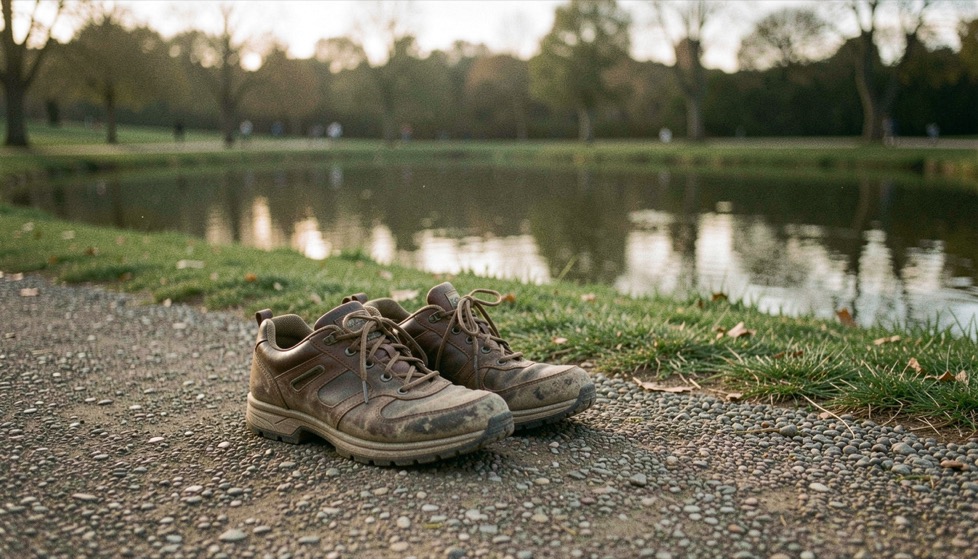
Shoes are the single purchase worth attention: a pair with cushioning that fits, replaced when the midsole flattens, typically after several hundred kilometers. Clothing follows weather, not fashion. Surfaces matter modestly: gravel and trails are kinder than concrete to joints, and hills add intensity for free. Poles turn a walk into more of a full body effort and help on descents. Nothing else on the gear shelf is required, whatever the advertisements say, because this magazine sells nothing and reviews nothing.
Making it survive the calendar
- Attach the walk to something already daily: the commute's last stop, the school run's return leg, the dog who has opinions.
- Keep a spare pair of shoes at work; the shoe is the meeting that never cancels.
- Choose the route for interest, not distance: a walk that is boring gets shortened by the walker.
- Track the week, not the day; a missed Tuesday is invisible in a good month.
The best walking pace is the one you will still choose in November.
One more honest paragraph: some bodies start with constraints, a painful joint, a lung condition, a heart already under treatment, and for those walkers the plan belongs with a clinician before it belongs on a calendar. Adapted activity remains activity, and rehabilitation programs are built precisely around that truth. For everyone else, walking is the front door to the totals described in the heart disease prevention steps, and the everyday heart checklist keeps the whole habit visible with one line to tick each week. If sitting, not walking, is the habit that needs attention first, the piece on sitting less picks up exactly there.
A walk is a good place to think about the rest of the week. personal budgets and direct payments explains who qualifies for support in England, heated wire circuits and condensation looks at a piece of hospital equipment, and preventing falls later in life gathers the small changes that keep people steady.
Questions readers actually ask
Is walking really enough, or does it have to be running?
For the general adult guidance, moderate activity is the target, and a brisk walk qualifies: the test is that you can talk but not comfortably sing. Running adds intensity, not a different category, and higher intensity counts double minute for minute in the guidance's arithmetic. The best activity is the one a real week can absorb, which for most people is walking.
How fast is a brisk walk?
Roughly five to six kilometers per hour is a common reference: the pace of someone late but composed. The talk test is more reliable than any number, because fitness, slope and wind shift the speed that produces moderate effort.
Do short walks count, or do I need thirty minutes at once?
Short bouts count toward the weekly total. Guidance has moved away from strict minimum session lengths: three ten minute walks and one thirty minute walk contribute to the same week.
Public sources cited on this page
Where to read next
- Sitting less, moving more every dayA morning workout does not neutralize nine seated hours.
- How the heart works, explained simplyA muscle the size of a closed fist moves blood through about one hundred thousand beats a day.
- Glossary sheet: blood pressureThe term blood pressure defined in one page of the signature glossary.
- The everyday heart checklistTen lines that compress every habit this magazine explains.