
The pump · Heart basics
How the heart works, explained simply
A muscle the size of a closed fist moves blood through about one hundred thousand beats a day. Here is what actually happens inside, told without jargon.
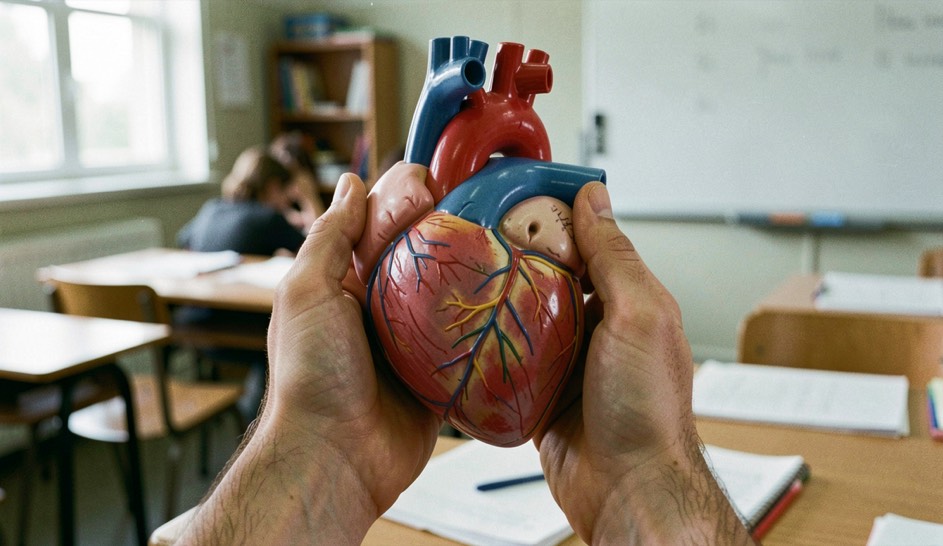
The heart is a hollow muscle, roughly the size of a closed fist, sitting slightly left of the center of the chest. Its job is unglamorous and relentless: it pushes blood through the body, beat after beat, for an entire lifetime. Public health educators often summarize its workload with a striking figure: on an average day the heart beats around one hundred thousand times, moving several thousand liters of blood. Nothing about that requires effort from you, and yet almost everything written in this magazine touches it.
Four chambers, two pumps side by side
Inside, the heart is divided into four chambers, two on the right and two on the left, and it is best understood as two pumps mounted on the same wall. The right side receives blood that has already traveled the body, delivered it to the lungs to pick up oxygen, then passes it along. The left side receives the freshly oxygenated blood from the lungs and pushes it back out to the brain, the muscles, the skin and every organ in between. The left side works harder, which is why its wall is noticeably thicker.
Between the chambers and at the exits sit four valves, thin flaps of tissue that open and close with each beat. Their job is traffic control: blood may only move forward. The familiar two-part sound of a heartbeat, often written as lub-dub, is the sound of valves closing, first the ones between chambers, then the ones at the exits. It is not the muscle itself you hear.
The electrical spark
Muscles need a signal to contract, and the heart generates its own. A small cluster of cells high in the right atrium, called the sinus node, fires an electrical impulse dozens of times a minute. The impulse sweeps across the atria, squeezes them, pauses at a relay point, then spreads through the ventricles so they contract from the bottom up, like a tube of toothpaste squeezed from the end. This self-generated rhythm is why the heart keeps working detached from your will, your attention and your sleep.
That electrical wave is also what an electrocardiogram records: not the sound of the heart and not the blood, only the electrical signature of each contraction. When a clinician reads an ECG, they are reading the timing and shape of these waves, looking for rhythm that is orderly or otherwise.
The heart feeds itself first
A detail that surprises many readers: the heart does not drink from the blood passing through its chambers. It has its own small network of arteries, the coronary arteries, branching off the aorta just above the aortic valve. They wrap the surface of the muscle and feed it. When people speak of clogged arteries or of a heart attack, they usually mean these coronary arteries: heart muscle that loses its blood supply is damaged, and that is the event medicine calls a myocardial infarction. The general process behind it, atherosclerosis, is described in plain words in our cardio glossary.
What changes from minute to minute
The heart is not metronomic. Climbing stairs, an argument, a fever, a strong coffee: the rate rises. Deep sleep, rest, long training: it settles. The nervous system adjusts pace and force continuously, without asking. The number of beats per minute at rest, and what it does and does not reveal, is covered in a companion piece about your pulse, and the pressure the beat generates is the subject of the blood pressure entry.
One beat is a small event. A lifetime of them, at the right pressure and a steady rhythm, is what public health calls cardiovascular health.
Why the mechanism matters for habits
Every recommendation this magazine covers, from walking most days to sleeping enough, from watching sodium to not smoking, traces back to this mechanism. Movement trains the pump and keeps the arteries supple. Excess sodium tends to raise the pressure the pump works against. Sleep is when blood pressure drifts to its lowest point of the day. None of these habits is heroic in isolation; each one simply lowers the daily load on a muscle that never takes a day off. The heart disease prevention steps that follow from it are gathered in one place, and the everyday heart checklist turns them into a short list you can actually keep.
Understanding the pump also clarifies what this magazine will never do: it does not interpret your heart, your readings or your symptoms. That work belongs to a clinician who can examine you. What plain physiology offers is context, the kind that makes a recommendation understandable instead of arbitrary.
The pump is only the beginning. Elsewhere in the magazine, infection control plan for a small shop covers cleaning, ventilation and staff cover in a shop, starting breath meditation takes a beginner through five quiet minutes at home, and what happens on a silent retreat describes a weekend taken in silence.
Public sources cited on this page
Where to read next
- Your pulse, explained in plain wordsYou can feel the heart's work from the outside, at the wrist or the neck.
- Pacemakers and Everyday ElectronicsMost household electronics are safe around an implanted device.
- Glossary sheet: blood pressureThe term blood pressure defined in one page of the signature glossary.
- The everyday heart checklistTen lines that compress every habit this magazine explains.